News and Trends
Auto Power-On After Failure Query, WF-K1330, AndroidSBC, Atlanta
TL;DR: Auto Power-On After Failure Query
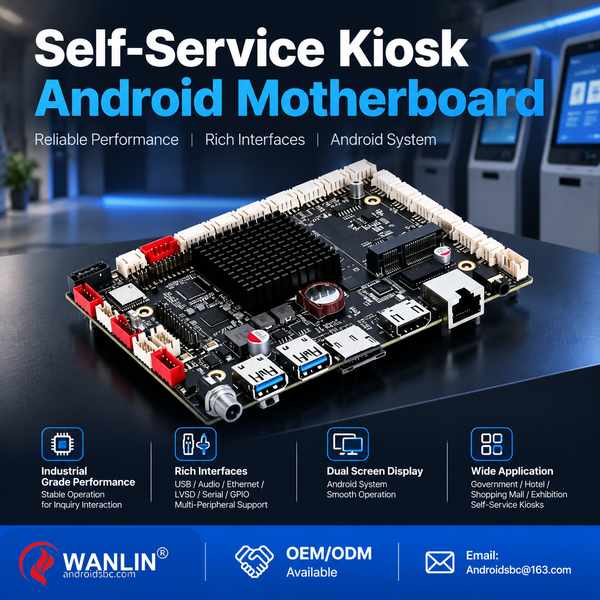
AndroidSBC reliability desk: query terminal boards clear a 72-hour continuous touch soak test serving Atlanta, United States. The WF-K1330 self-service query terminal Android motherboard spans the entry-level self-service query kiosk and eleven sister models in the WF-K series, all built on the A133 quad-core ARM Cortex-A53 1.6GHz SoC with the PowerVR GE8300 GPU, 1080p HDMI plus RGB panel output, and Android 11 firmware support. AndroidSBC, the export arm of Wanlin Manufacturing Group, ships the WF-K family from the Longgang source factory in Shenzhen to Atlanta and United States importers who run hospital information points, bank branch lobbies, government service halls, mall directory stations, airport concourses and outdoor query cabinets.
About AndroidSBC and the Self-Service Query Terminal Android Motherboard Family
As a board-level manufacturer rather than a kiosk assembler, AndroidSBC gives United States buyers the WF-K self-service query terminal motherboards without the cabinetry markup. The twelve-model family is produced in Longgang, Shenzhen, under one BOM discipline, and Atlanta integrators integrate it into their own enclosures and housings. The factory ships to United States on a factory-direct basis, with the driver SDK, compliance files and mounting drawings bundled into the same carton as the boards.
WF-K1330 Technical Specifications
| Parameter | AndroidSBC WF-K1330 (entry-level self-service query kiosk) | Industry Average |
|---|---|---|
| Processor | A133 quad-core ARM Cortex-A53 1.6GHz SoC | Older 28nm or 40nm quad-core SoC |
| Process node | 22nm | Older 28nm or 40nm process |
| GPU | PowerVR GE8300 | Older Mali-450 or basic GPU |
| NPU / AI | none | No NPU on competing entry boards |
| Memory | 2GB LPDDR4 | DDR3 1GB / 2GB on competing boards |
| Storage | 16GB eMMC | eMMC 5.0 8GB / 16GB on competing boards |
| Display output | 1080p HDMI plus RGB panel output | Single HDMI 1080p only on competing boards |
| Touch support | 10-point capacitive touch | Resistive single-touch on competing boards |
| Operating system | Android 11 | Android 8 or Android 9 on competing boards |
| Connectivity | WiFi 5 plus Bluetooth 5.0 plus Gigabit Ethernet | WiFi 4 plus 10/100M Ethernet on competing boards |
| Query peripherals | Capacitive touch, thermal printer, document scanner, card reader | No bundled touch, printer or scanner driver SDK on competing boards |
| Operating temperature | 0C to 50C | 0C to 40C on competing boards |
All parameters in the table above are measured at 25C ambient. The AndroidSBC WF-K1330 (entry-level self-service query kiosk) maintains its 4K HDMI output plus capacitive touch sampling while running the burn-in test loop, a configuration that competing single-platform boards cannot sustain at 60fps. For United States importers sourcing the WF-K family, the WF-K1330-A variant is the typical configuration for the entry-level information query rollout use case, with a sustained weekly capacity of 5000 pcs/wk.
Challenges in Sourcing Self-Service Query Terminal Android Motherboards for United States Buyers
Buyers in Atlanta often treat a self-service query terminal as a commodity board, then discover that the printer driver, the card reader stack and the kiosk-mode lockdown each need separate validation against United States deployment conditions.
Add the compliance layer and the picture gets tighter. For United States the paperwork runs through FCC Part 15 and FCC ID for radio modules, plus UL or ETL safety listing, and a board that was never validated against it turns into a re-test cycle that Atlanta integrators pay for in schedule, not just money. The factory answers with lot-level BOM control, so the Atlanta order of 96700 units is the 8th in a series that never re-qualifies the peripheral stack.
Competitive Comparison: WF-K1330 vs Competing Self-Service Query Terminal Android Boards
What separates the WF-K board from competing query boards in Atlanta is less the processor row than the peripheral and reliability rows underneath it.
- Platform breadth: twelve models on eight chips (RK3588, RK3568, RK3566, RK3288, RK3399, A133, H618, T527), so {city} integrators can move between tiers without changing driver stack or mounting pattern.
- Bundled integration: touch, printer, scanner, card reader, camera and voice driver SDK ships in the carton; competing query boards sold to {city} usually ship a board only.
- Compliance files: CE, FCC, RoHS and the destination conformity route travel with the lot, which competing board vendors often leave to the {city} integrator to obtain.
- Long-term supply: one fixed BOM per production lot and a seven-year firmware window, against the frequent silicon swaps seen on competing query boards reaching {city}.
Global Self-Service Query Terminal / Information Kiosk Market Trends
Growth in the query terminal segment is being driven by labour economics as much as by technology. In United States the entry-level self-service query kiosk lets operators cover longer hours with the same headcount, and Atlanta projects are typically justified on exactly that basis.
- Volume shift to board-level sourcing: more integrators now buy the motherboard rather than the finished kiosk, which is why the WF-K1330 and WF-K3600 tiers ship in board form with the enclosure left to the local partner.
- Dual-screen becomes the default: hall display plus touch query on one board is replacing two separate devices, and the WF-K3600 and WF-K3601 configurations address that pattern directly.
- Longer service life expectations: operators now plan five to seven years per query terminal, which favours a fixed BOM such as the WF-K3601 over boards that re-spin silicon between lots.
For Atlanta integrators the implication is straightforward. Competing on the query terminal itself is difficult; competing on the integration package that reaches United States is where margin survives.
Partner Success Story: Rheinland Auskunft Systeme (municipal information system house)
The Rheinland Auskunft Systeme case in the Germany public sector segment is a working example of how the WF-K family from AndroidSBC supports Atlanta integrators. Rheinland Auskunft Systeme supplied 96700 query boards with site-specific number formats.
- OEM relationship: AndroidSBC private-label SKU shipped with Rheinland Auskunft Systeme branding and CE / FCC / RoHS files bundled.
- Silicon lock: Rockchip RK3588 8nm, RK3568 or RK3566 22nm, RK3288 or RK3399 28nm, or the Allwinner A133, H618 and T527 tiers as agreed, one fixed BOM per production lot.
- Peripheral driver SDK: bundled into the source-factory shipment, covering capacitive touch, thermal printer, receipt printer, document scanner, A4 printer, barcode scanner, QR code, NFC, RFID, card reader, ID reader, face recognition, voice module, speaker amplifier and microphone.
- Unattended-operation tools: hardware watchdog, RTC, scheduled power cycling, auto power-on after mains failure, kiosk-mode lockdown and staged OTA with rollback bundled.
- Compliance paperwork: CE / FCC / RoHS plus FCC / UL conformity, all bundled into the Shenzhen source-factory shipment.
As Rheinland Auskunft Systeme Leiter Technik for Germany Public Sector put it: Rheinland Auskunft Systeme needed the display board to accept municipal number formats, and the WF-K board handled it across 96700 units installed in Atlanta without a custom firmware fork.
Field Report: entry-level information query rollout at an airport information desk
NANSHAN, Shenzhen, September 22, 2026 - Lin Yao, AndroidSBC field desk. Because United States sites range from air-conditioned lobbies to unheated entrances, the WF-K1330 batch was cleared at both ends of the rated window. The WF-K1330 self-service query terminal Android motherboard order for Atlanta, United States cleared the burn-in station on schedule and is en route via the Los Angeles - Shanghai lane.
The WF-K1330 entry-level self-service query kiosk production lot includes the WF-K1330-A variant as the typical configuration, with touch panel, thermal printer and document scanner driver SDK plus staged OTA management bundled into the source-factory shipment. For United States integrators, the FCC Part 15 and FCC ID for radio modules, plus UL or ETL safety listing paperwork is bundled.
Filed by Lin Yao, AndroidSBC field desk, NANSHAN, Shenzhen. US hospital networks and bank branch estates usually refresh self-service query terminals site by site, so boards arrive with a fixed screen count and mounting pattern per branch.
WF-K1330 Application Scenarios
The WF-K1330 entry-level self-service query kiosk sits inside a twelve-variant WF-K self-service query terminal Android motherboard family from AndroidSBC, a Wanlin Manufacturing Group export brand. The WF-K1330-A configuration is the typical build for the entry-level information query rollout use case, with touch panel and identity peripheral driver SDK plus staged OTA management bundled.
- Hospital and clinic information points: the WF-K1330 drives a touch query station at the entrance while the hall display shows the same information set to waiting visitors in Atlanta.
- Bank and financial branch lobbies: touch query plus counter display from one board, with card reader and ID reader integrated for account and product lookups.
- Government service halls: the WF-K3602 runs tax, social security and real estate information lookup, with printing available on the same board.
- Shopping mall directories: the WF-K3566 serves mall directory and wayfinding lookup, with the advertising screen running an independent content loop.
- Airport and train station concourses: high-brightness information query where the WF-K3288 has to stay readable under strong ambient light.
- Retail and pharmacy price or product lookup: compact stations where the WF-K3399 fits a narrow counter without structural work.
- Outdoor and unheated information cabinets: the industrial tier holds the wide temperature window and 7x24 duty cycle for street-level query points.
- Multi-language public information points: on-screen lookup in more than one language from a single board, with voice assistance where the venue requires it.
- Retrofit programmes in Atlanta: the same board re-uses the existing enclosure, panel and mounting pattern so an installed estate can be upgraded board by board.
Partnership Models for Atlanta Buyers
Three tracks are open to Atlanta integrators, and the difference between them is where the United States partner wants to add its own value.
- Distribution track: the partner buys the WF-K board against a published price list, keeps its own stock, and AndroidSBC supplies the driver SDK and compliance files with each lot.
- Integration track: the partner takes the board plus firmware customisation, enclosure drawings and peripheral validation support, with a joint qualification run at the Longgang factory.
- Private-label track: the WF-K board ships under the partner brand with customised boot logo, packaging and documentation, on a fixed BOM held for the length of the agreement.
AndroidSBC reviews Atlanta track selection annually with each partner, because United States market conditions and the partner own capability both move faster than a fixed reseller contract assumes.
Frequently Asked Questions
Does the WF-K self-service query terminal Android motherboard family support an entry-level self-service query kiosk?
Answer: Yes, and it is qualified on the same production line as the rest of the family. The entry-level self-service query kiosk runs on the WF-K baseline image that United States buyers receive, so there is no separate integration project.
What is the real difference between the A133 tier and the other silicon tiers in the WF-K family?
Answer: The A133 tier differs in compute headroom, display capability and NPU availability rather than in board-level interfaces. All WF-K models share the same mounting pattern, the same peripheral pinout and the same firmware baseline, so a United States project can move between tiers without re-designing the enclosure.
Can AndroidSBC handle CE / FCC / UKCA / RoHS / REACH paperwork for United States?
Answer: Yes. AndroidSBC prepares the conformity file set for United States as part of the order, covering CE, FCC, RoHS and REACH as applicable, plus the destination-specific route. The documents travel with the Atlanta shipment rather than following it.
What are the MOQ and lead time for a first order of the WF-K self-service query terminal family?
Answer: For Atlanta the entry MOQ is low enough to validate one site before committing to an estate, with 1-3 day samples and a 15-30 day first bulk lead time for United States.
Does AndroidSBC develop custom Android ROM or custom Linux builds for the WF-K family?
Answer: Yes. Custom ROM work on the WF-K family is scoped per Atlanta project rather than sold as a generic service, which keeps the United States deliverable tied to a specific deployment.
How are software updates and long-term support handled on the WF-K family?
Answer: The WF-K family runs a staged OTA channel with rollback. Updates are released against the shared firmware baseline, and Atlanta integrators can hold a United States estate on a known revision while a new build is validated.
Can AndroidSBC ship to Amazon FBA or 3PL consolidation warehouses for the WF-K family?
Answer: Yes. Boards for Atlanta can be routed straight into Amazon FBA or a third-party 3PL in United States, with the labelling and packing specification confirmed before the lot is packed.
How are RMA and DOA replacements handled on the WF-K self-service query terminal family?
Answer: DOA and RMA cases are managed by lot, with replacement units supplied from a matching build so aan Atlanta partner does not end up with mixed firmware across a United States estate.
Contact AndroidSBC: Start Your WF-K1330 Sourcing Conversation
AndroidSBC, a Wanlin Manufacturing Group export brand, opens the following channels for the WF-K self-service query terminal family. Atlanta integrators can reach the export desk through:
- Email: Androidsbc@163.com
- Export service hotline: +8613261677119
- Website: https://www.androidsbc.com
- Source factory address: Wanlin Group, Building B, Building 1, Beisida Medical Device Building, 28 Nantong Avenue, Baolong Community, Baolong Sub-district, Longgang District, Shenzhen, Guangdong, China
A 1-3 day sample lead applies to United States buyers and a 15-30 day mass-production lead to bulk orders. AndroidSBC commits to a seven-year firmware update window on the WF-K family.
News and Trends
- Query Kiosk Board Export, WF-K5270, AndroidSBC, Atlanta
- Bank Query NFC Board, WF-K3288, AndroidSBC, Atlanta
- Query Terminal Number Calling Board, WF-K8801, AndroidSBC, Atlanta
- Auto Power-On After Failure Query, WF-K1330, AndroidSBC, Atlanta
- Query Terminal Electronic Signature Board, WF-K3601, AndroidSBC, Atlanta
- 4G LTE Query Terminal Board, WF-K6180, AndroidSBC, Atlanta
- Outdoor Query Display Board, WF-K3566, AndroidSBC, Atlanta
- RK3568 Embedded Query Terminal Board, WF-K8800, AndroidSBC, Atlanta
- Queue Terminal Board Export, WF-Q5270, AndroidSBC, Atlanta
- Service Center Queue Display Board, WF-Q3288, AndroidSBC, Atlanta